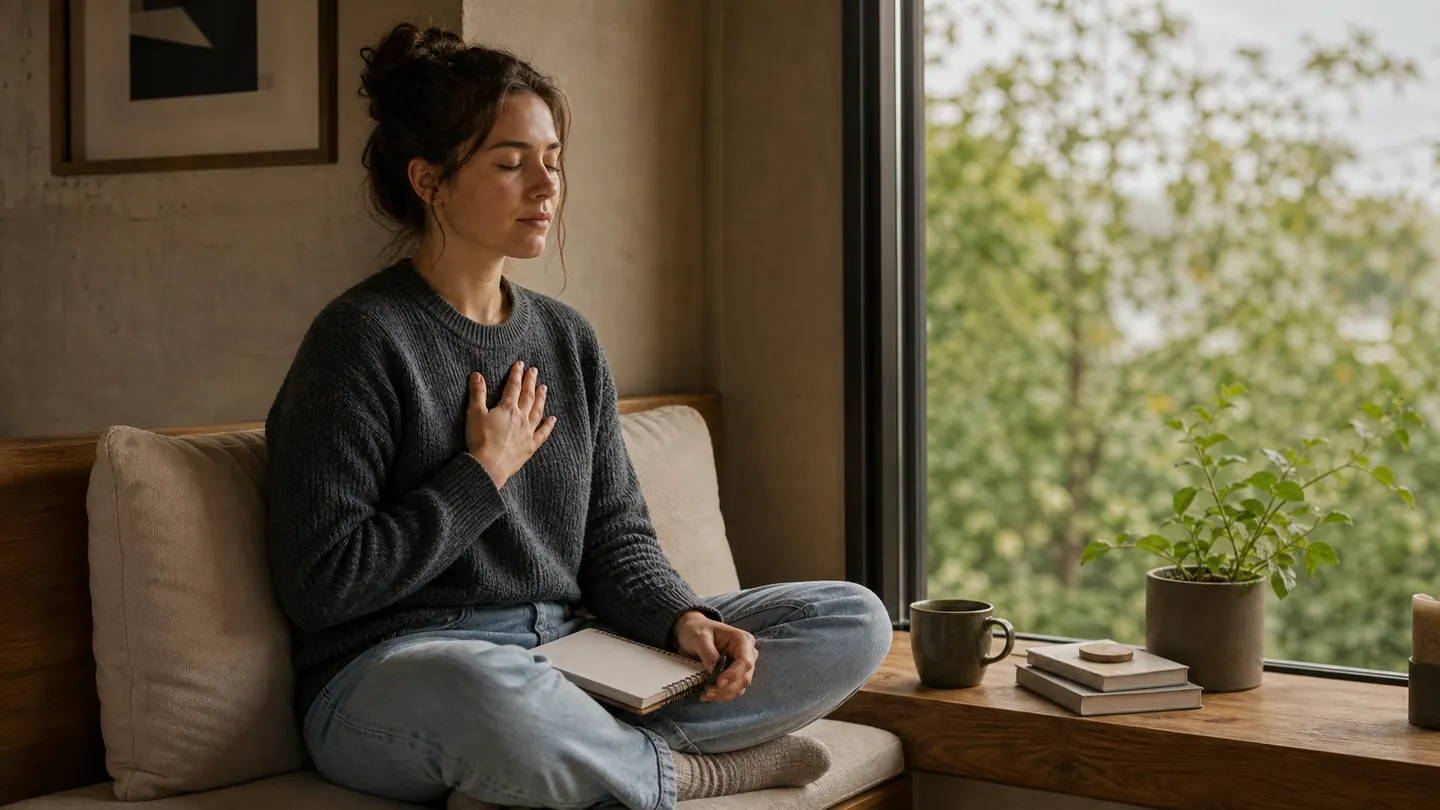
An anxious moment does not automatically mean an anxiety disorder, and a breathing exercise is not a diagnostic test. The National Institute of Mental Health distinguishes ordinary anxiety from disorders in which fear or worry does not go away, appears across situations, can worsen, and interferes with everyday life. That distinction gives light regulation tools their proper role: they may help you settle enough to choose a next step, but they cannot tell you what condition you have or replace care when symptoms are severe.
The useful claim is modest. Low-intensity practices can be reasonable self-care for a manageable episode. The risky claim is that every anxious state can be controlled privately if you find the right technique or try hard enough.
Why quick regulation advice is appealing
Anxiety creates urgency. A short video, app, breathing pattern, or grounding prompt offers something concrete when your attention feels captured by threat. Some of these practices are also inexpensive, private, and easy to repeat.
Those advantages are real. Problems begin when immediate relief is marketed as proof that a method treats an anxiety disorder, or when failure to feel calm is framed as poor discipline. A person may also keep adding techniques while overlooking medication effects, substance use, sleep loss, a medical problem, sustained danger, or a mental-health condition that needs assessment.
What light tools can reasonably do
NIMH includes breathing or meditation, regular movement, supportive contact, regular meals, sleep, and low-stress activities among self-care options that may help with milder symptoms. Treat these as experiments in support, not as guaranteed interventions.
In a workable moment, choose one small action:
- slow down and notice what is happening around you rather than arguing with every thought;
- make the exhale comfortable and unforced, stopping if breath-focused attention makes you feel worse;
- reduce optional stimulation, such as notifications or a tense conversation you can safely pause;
- take a short, ordinary movement break if movement is accessible to you;
- tell a trusted person plainly: “I am anxious and could use company while I decide what to do next.”
The desired outcome is not perfect calm. It is enough room to assess safety, function, and the next useful action. If a practice increases dizziness, panic, fixation, pain, or distress, stop it. There is no prize for forcing a technique that does not fit.
A better check than a symptom score
Online advice often turns anxiety into a number and invents a cutoff. A more informative review uses observations:
- Context: What happened before the anxiety rose? Was there conflict, uncertainty, poor sleep, substance use, illness, or a real threat?
- Function: Can you still care for yourself, communicate, work or study, and make basic decisions?
- Course: Is the pattern easing, repeating, spreading to more situations, or becoming harder to recover from?
- Avoidance: Are you progressively giving up places, people, responsibilities, or necessary care to avoid the feeling?
- Safety: Are there thoughts of self-harm, harm to someone else, inability to stay safe, violence, or a possible medical emergency?
Write down concrete observations rather than trying to diagnose yourself. “I left work twice this week because I could not remain in the room” gives a clinician more useful information than “my anxiety was eight out of ten.”
Signals not to explain away
Seek professional assessment when anxiety is persistent, worsening, repeatedly disrupting sleep or daily responsibilities, narrowing your life through avoidance, or leading you to rely more heavily on alcohol or other substances. NIMH advises considering how symptoms affect daily life and speaking with a health professional when self-care does not help or symptoms worsen.
Some physical symptoms commonly associated with panic can also occur in medical emergencies. New, severe, or concerning chest pain, breathing difficulty, fainting, confusion, or other acute physical symptoms should not be self-diagnosed as anxiety. Use local emergency medical services or seek urgent medical evaluation.
If you may harm yourself or someone else, cannot stay safe, are experiencing violence, or face a life-threatening situation, skip further self-experimentation. Follow the localized urgent-help guide and contact emergency or crisis support now.
What to verify before buying an anxiety solution
Commercial anxiety content often blends education, treatment claims, and testimonials. Before paying, ask:
- What exact outcome is promised: temporary comfort, skill practice, or treatment of a condition?
- Is the claim supported by evidence about this specific service or product, or only by a general study about relaxation?
- Are qualifications, costs, renewal terms, privacy practices, and limits stated clearly?
- Does the seller tell you when the product is not appropriate and where to seek qualified care?
- Do testimonials imply results that the evidence cannot establish?
The U.S. Federal Trade Commission’s health-claims guidance says objective health-benefit claims need competent and reliable scientific evidence; testimonials do not substitute for that support. Fine print does not rescue an inflated promise.
What useful support can look like
If the pattern needs more than self-care, the next step does not have to begin with a perfect label. You can bring a primary-care or mental-health professional a short record of:
- what you experience in your own words;
- when it happens and what seems to precede it;
- how sleep, work, relationships, eating, movement, and avoidance have changed;
- substances, supplements, and medicines you use;
- what you tried and whether it helped, did nothing, or made things worse;
- any immediate safety concerns.
Ask how they are thinking about possible causes, what assessment is needed, what options exist, what risks or side effects matter, and how progress will be reviewed. This keeps you involved without asking self-help content to perform a clinical role.
For a wider decision map, see Self-help or therapy: how to understand the boundary and When self-help is not enough.
A practical use case
Suppose you feel a surge of anxiety before a meeting. You can still speak, make decisions, and remain safe. You pause notifications, orient to the room, breathe without strain, and message a colleague that you need a minute. The intensity becomes workable, and you later note that the pattern follows several nights of poor sleep. A light tool served its purpose: it created room for observation and a practical adjustment.
Now change the facts. The episodes are spreading beyond meetings, you are avoiding travel and work, sleep is deteriorating, and the tools no longer restore function. Repeating the same exercise with more force is not disciplined regulation. It is evidence that the support plan needs to widen.
The boundary that keeps self-help useful
Use light tools for light work: settling, observing, asking for support, and making the next decision. Do not use them to declare that a medical symptom is harmless, diagnose an anxiety disorder, process severe distress alone, or postpone help while function or safety declines.
This is general education, not diagnosis or individualized treatment. A qualified health professional can assess symptoms in context. Urgent and life-threatening situations require local emergency or crisis services, not another self-help exercise.