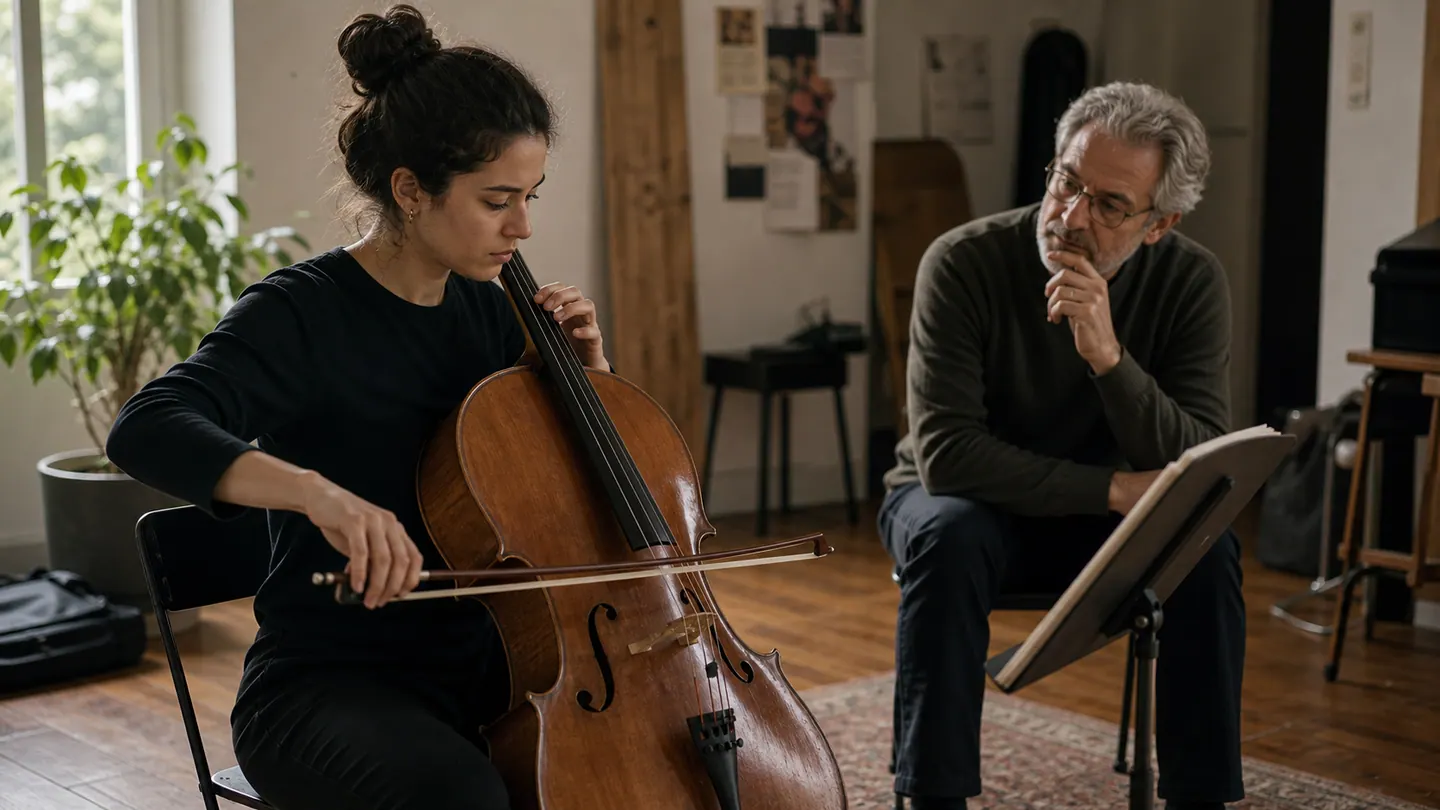
Becoming more capable at a difficult activity usually involves two related processes. Learning builds knowledge, discrimination, technique, and memory. Creative work recombines those materials to produce an attempt that is both new and appropriate for a particular domain. Neither process guarantees mastery, recognition, employment, or income. Both become more useful when the next attempt is specific enough to examine.
Early awkwardness is information, not proof of hidden talent or permanent inability. It may reveal missing knowledge, poor instruction, an exercise that is too large, limited access to feedback, fatigue, or a mismatch between the task and current conditions. Good practice turns that information into a revised attempt.
Define the Hard Thing Narrowly
"Learn design," "become creative," and "master writing" are identities, not practice targets. A narrower target describes a performance:
- arrange one screen so its visual hierarchy is clear;
- explain a concept without consulting notes;
- play a passage accurately at a manageable tempo;
- draft three different openings for the same argument;
- diagnose one recurring error in a spreadsheet model.
The target should make comparison possible. "Better" might mean fewer factual errors, clearer structure, more reliable recall, a wider range of alternatives, or a result that fits stated constraints. The guide to how skills develop helps distinguish a trainable component from a vague ambition.
Creativity Needs Knowledge and Conditions
Teresa Amabile's componential theory of creativity describes creative output as novel and appropriate, shaped by domain-relevant skills, creativity-relevant processes, task motivation, and the social environment. It is a scholarly framework, not proof that a checklist produces valuable work.
The definition nevertheless corrects two common mistakes. Novelty alone is not enough: a surprising bridge design that cannot carry its load is not successful engineering. Technical correctness alone is also incomplete when the task calls for an original solution. Creative judgment belongs to a domain, audience, and purpose.
Knowledge supplies materials to vary. Constraints give the attempt something to answer. Motivation and environment affect whether exploration is possible. The creative-genius critique explains why ideas should not be reduced to mysterious personal essence.
Practice Explains Part of Performance
Practice matters, but it is not the whole causal story. An independent meta-analysis of deliberate practice found that deliberate practice accounted for part, not all, of observed performance variation, with substantial differences across music, games, sports, education, and professions.
Group-level estimates cannot predict an individual's result. Definitions and measurements are disputed, and performance is also shaped by prior knowledge, instruction, feedback, opportunity, resources, health, access, and domain characteristics. No fixed number of hours creates mastery.
A better use of the idea is modest: select a component that matters, attempt it at an appropriate difficulty, obtain informative feedback, and adjust. Deliberate practice without the mythology offers a more detailed treatment, while the 10,000-hour myth addresses the popular threshold claim directly.
Use Learning Methods for the Material They Fit
The U.S. Institute of Education Sciences practice guide on organizing study gives recommendation-specific evidence ratings for practices such as spacing learning, alternating worked examples with problem solving, retrieval, delaying judgments of learning, and asking explanatory questions.
The educational scope matters. The guide does not establish one universal adult-learning system or creative routine. Still, it suggests a useful distinction between exposure and retrieval. Rereading can create familiarity; trying to explain an idea from memory reveals what can actually be produced.
For knowledge-heavy skills, active recall and spaced repetition may help retain relevant material. For open-ended creative work, retrieval is only one ingredient. Producing variations, receiving domain-specific critique, and judging fit remain necessary.
Build a Produce–Inspect–Revise Loop
A practical loop can be organized as follows:
- choose one narrow performance;
- study one relevant example or principle;
- produce an attempt without hiding inside preparation;
- inspect the result against explicit criteria;
- obtain feedback where it adds information;
- revise one or two variables;
- record the next question.
This is a Gollius editorial adaptation, not a validated universal sequence. Some fields require supervised instruction, safety controls, equipment, collaboration, or certification. The loop should yield to those requirements.
The essential move is to let output answer back. Notes that never become a draft, exercise, explanation, or decision can preserve the feeling of learning while avoiding a performance. Notes that become output can help close that gap.
Ask for Feedback That Can Change the Next Attempt
"Is this good?" invites taste, reassurance, or a verdict. A better request identifies the decision:
- Which step becomes hard to follow?
- Where does the argument rely on an unstated assumption?
- Which of these variations best satisfies the brief, and why?
- What error repeats across the three attempts?
- What should remain unchanged in the next revision?
Feedback is evidence from a perspective, not an order. The source may lack context or judge against different aims. Compare comments with the criteria and preserve authority over the work. Useful feedback includes ways to request critique without turning every opinion into a command.
Vary Attempts Without Changing Everything
Repeating the exact same attempt can stabilize technique, but it may also stabilize an error. Changing every variable prevents learning because the cause of improvement or decline becomes opaque.
Try constrained variation. A speaker might deliver the same explanation with three examples. A designer might preserve content while changing hierarchy. A programmer might solve related problems that require the same concept in different forms. Variation tests whether knowledge can be used rather than merely copied.
Creative blocks sometimes reflect fear or perfectionism, but they can also reflect unclear constraints, missing domain knowledge, exhaustion, or an unsuitable system. The creative-block guide keeps those possibilities open.
Protect Recovery and Access
Strain is not a reliable measure of learning. Practice quality can fall when attention, sleep, physical capacity, or emotional bandwidth is depleted. Difficult activities may also require equipment, money, safe space, teaching, or time that is unevenly available.
A plan that ignores these conditions can turn privilege into a character story. Adjusting duration, using accessible tools, changing the target, seeking instruction, or pausing is part of intelligent practice. It does not prove a lack of commitment.
Recovery is especially important when errors carry physical, professional, or safety consequences. In those contexts, practice should occur within the appropriate supervision and standards.
Review Evidence Without Promising Mastery
After a bounded series of attempts, review what changed:
- Which component improved under the chosen criterion?
- What remains unreliable?
- Which feedback was specific and useful?
- Did the task difficulty permit learning?
- What conditions supported or obstructed practice?
- Is the next investment proportionate to the value of the skill?
Progress may be uneven, domain-specific, and difficult to measure. A strong week does not prove a final trajectory; a weak attempt does not settle potential.
Becoming good at hard things is not a heroic identity. It is an ongoing relationship among knowledge, attempts, feedback, conditions, and revision. Define the performance, use evidence that fits the domain, make something inspectable, and revise without turning effort into a guarantee. Capability grows through that loop when the activity, resources, and circumstances allow it—and the outcome remains open.