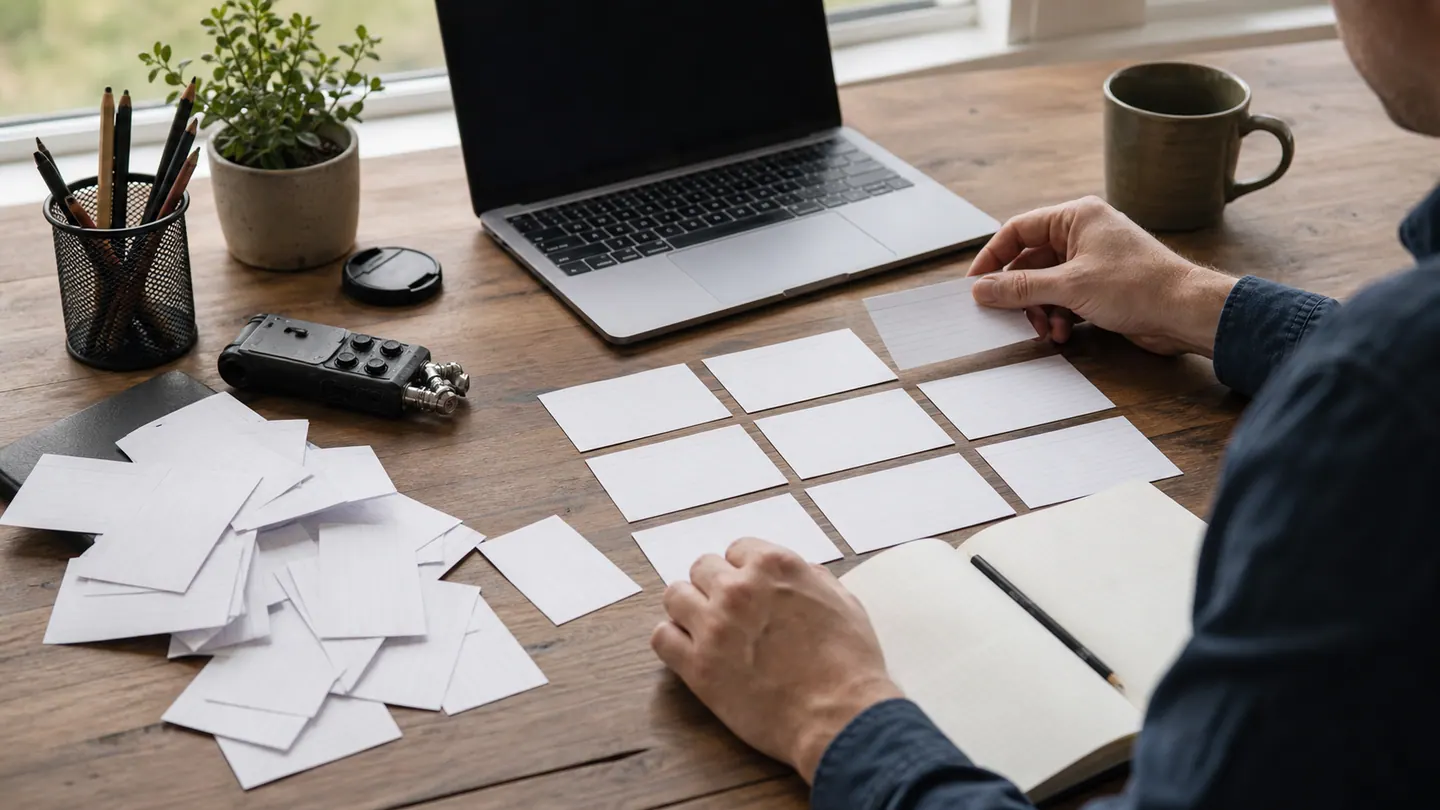
For creators, a note system is not successful because it looks intelligent. It is successful when notes become drafts, decisions, scripts, sketches, essays, lessons, products, questions, or better taste.
The trap is collecting more than you can metabolize. Highlights, quotes, screenshots, saved posts, voice memos, app experiments, and elaborate tags can create the feeling of a rich creative life while the real work remains thin.
Notes become more useful when they act as a production system. If your larger problem is sitting down to make the work, pair it with writing and craft.
Capture less, but with a destination
Before saving something, ask: what could this help me make?
Possible destinations:
- a paragraph;
- a scene;
- a talk;
- a product decision;
- a teaching example;
- a design reference;
- a question to investigate;
- a point to challenge.
Not every interesting thing deserves permanent storage. Some ideas are pleasant sparks with no future use. Letting them pass is not intellectual laziness. It is creative hygiene.
Separate raw material from your thinking
A copied quote is not yet a note. A saved article is not yet understanding. A transcript is not yet insight.
Add your own layer:
- Why did this catch my attention?
- What do I agree with?
- What feels incomplete?
- Where have I seen this in real work?
- How might I use, test, or contradict it?
This protects originality. It also keeps authorship clean. If you later publish with someone else's words, examples, or distinctive ideas, handle attribution properly. A messy archive should not become an excuse for accidental borrowing.
Use project-first retrieval
Creators often retrieve by project, not by abstract category. A note about attention might belong to an essay, course, video, product, workshop, or personal experiment.
Create one simple project file:
- working title;
- audience or use;
- core question;
- rough outline;
- related fragments;
- next output step.
Then move useful notes into that file. The system becomes alive when material gathers around active work. A global library can still exist, but it should not be the place where ideas go to retire.
Keep categories functional
Avoid building a taxonomy so ornate that maintaining it becomes your new creative practice.
Five buckets are enough for many people:
- Inbox: uncooked captures waiting for review.
- Sparks: fragments that may become something.
- Sources: references that need attribution or verification.
- Projects: notes attached to active work.
- Output: drafts, outlines, scripts, sketches, publishable pieces.
The most important movement is from inbox to project to output. If notes only move sideways between folders, the system is busy but not productive.
Convert notes on a schedule
Notes lose context quickly. A phrase that felt electric on Tuesday may look dead by Friday because you no longer remember the problem it answered.
Run a short weekly conversion:
- Open the week's captures.
- Delete what has no use.
- Attach useful fragments to active projects.
- Turn one note into a rough paragraph, sketch, outline, or prompt.
- Write one question for next week.
The review should be short enough to repeat. If it becomes a ceremonial audit, you will avoid it.
Link notes to practice, not only ideas
Creators do not need only concepts. They need moves.
Turn notes into practice prompts:
- "Write three openings using this tension."
- "Sketch this layout principle in a different domain."
- "Explain this idea without jargon."
- "Use this example in a draft, then cut it if it does not earn its place."
This connects notes to deliberate practice. The note becomes a training object, not a collectible.
Beware app-driven procrastination
Tool switching can feel like progress because every new app promises a cleaner future. Sometimes a tool change is justified. Often it is avoidance with a subscription.
Use the boring test: can you capture, retrieve, and convert ideas with less friction than before?
If the answer is no, the system is not helping. Plain text files, a notebook, index cards, or a simple notes app can be enough. The goal is not to impress other note-takers. The goal is to make.
Use notes to support memory selectively
Some notes contain information you need to recall: terms, frameworks, distinctions, examples, procedures. Turn those into questions and review them lightly over time.
For that side of learning, active recall and spaced repetition is the better tool. But do not turn every creative note into a flashcard. Some notes are meant to become output, not permanent memory.
A simple creator note workflow
Try this for two weeks:
- Capture only what has a possible destination.
- Add one sentence of your own thinking to each useful note.
- Attach notes to active projects within seven days.
- Convert at least one note per week into visible output.
- Delete or archive the rest without guilt.
Good notes do not make you look like a creator. They help you create. The archive is not the achievement. The achievement is the work that finally leaves it.