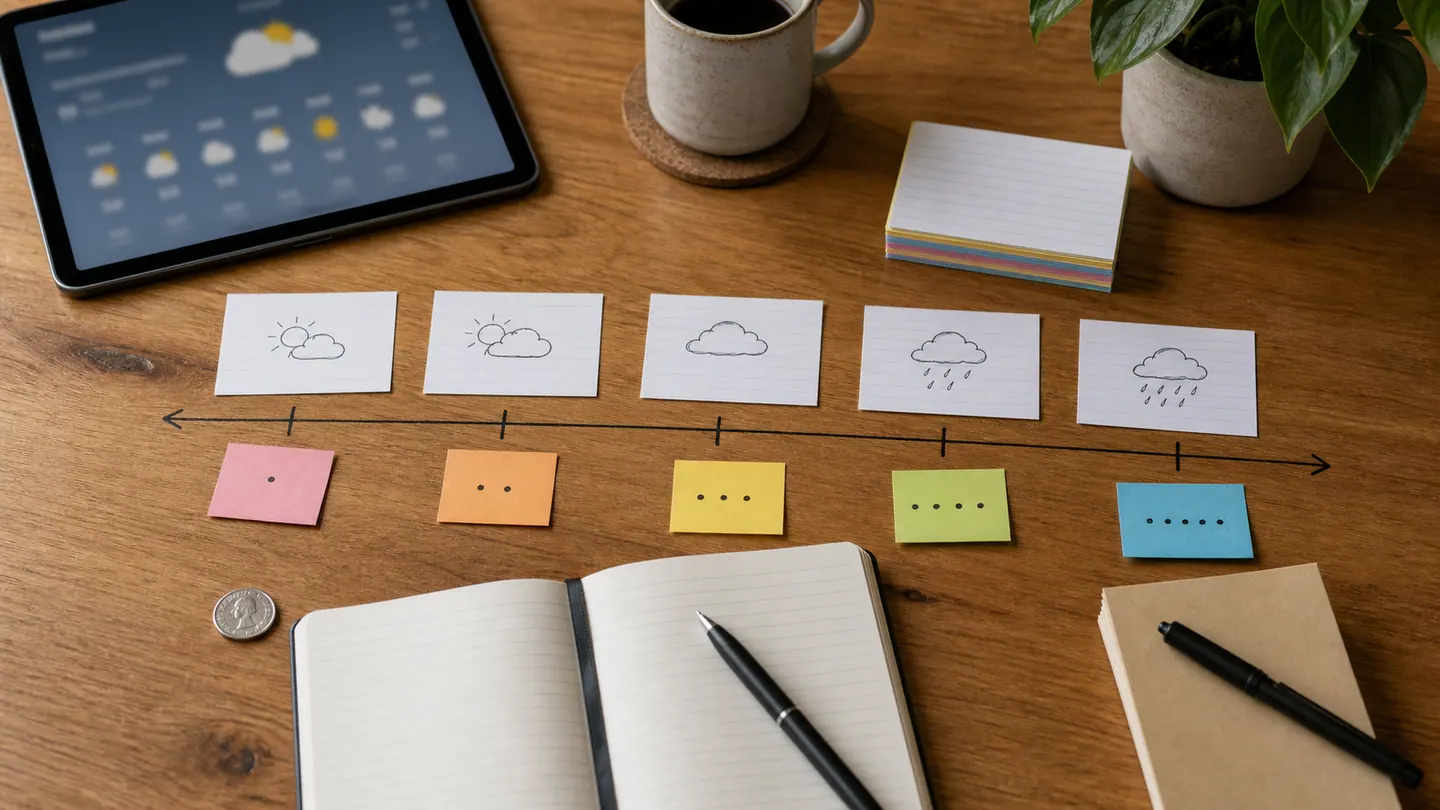
Probabilistic thinking is the habit of saying "how likely?" instead of only "true or false?" It does not make you cold or indecisive. It makes your confidence more honest.
Most important decisions happen under uncertainty. You rarely know for sure whether a plan will work, whether a person will respond well, whether a project will be worth it, or whether your first interpretation is accurate. The goal is not perfect prediction. The goal is to avoid pretending that a guess is certainty.
This belongs inside critical thinking and decision making because many weak choices are not caused by ignorance alone. They are caused by confidence that is too high, too low, or attached to the wrong evidence.
Why degrees of confidence matter
Binary thinking feels clean: right or wrong, safe or unsafe, good idea or bad idea. Real life is messier. A job offer can be promising with hidden risks. A conflict can be partly your responsibility and partly the result of a bad system. A health concern can be unlikely and still worth checking. A self-help claim can be useful in one context and misleading in another.
When you think in degrees, you give yourself room to update. "I am 70 percent confident this is the right next step" is more useful than "I know this will work." It invites preparation, review, and humility.
Degrees of confidence also reduce overreaction. If you notice that your fear is saying "this will definitely go badly," you can ask, "What probability would I assign if I were calmer?" That question does not dismiss the fear. It makes it easier to work with.
It also reduces false reassurance. If hope says, "This will definitely work," a degree of confidence asks, "How much evidence do I actually have, and what could still go wrong?"
A simple way to practice
Use three questions:
- What do I currently believe?
- How confident am I?
- What evidence would change my mind?
For ordinary decisions, you do not need exact mathematics. You can use plain ranges:
- Low confidence: I have a hunch, but little evidence.
- Medium confidence: I have some evidence, but important uncertainty remains.
- High confidence: I have repeated evidence and few serious alternatives.
The key is not the number. The key is noticing whether your confidence matches the quality of your evidence.
If a belief feels emotionally protected, pair this with the guide to confirmation bias. A probability estimate is only useful if you are willing to look for evidence that could lower it.
Everyday examples
If you think "my colleague is ignoring me," probabilistic thinking asks: what else could explain the delay? Maybe they are busy. Maybe your message was unclear. Maybe they disagree. Maybe there is tension. Each explanation has a different probability and suggests a different next action.
If you think "this habit system will fix my mornings," probabilistic thinking asks: what is the base friction? Is the problem planning, sleep, childcare, commute, mood, workload, or unrealistic expectations? The method may help one part and fail at another.
If you think "I should quit this project," probabilistic thinking asks: what are the likely costs of staying, leaving, pausing, or renegotiating? You do not need certainty before making a decision, but you do need to know which uncertainty you are accepting.
If you think "this creator understands my whole problem," probabilistic thinking asks whether the explanation is plausible, complete, or simply resonant. A claim can fit part of your situation without deserving total loyalty.
Avoid false precision
Probabilistic thinking can become another performance game if you pretend to know exact probabilities you cannot know. Do not decorate weak guesses with precise numbers. "I am 63 percent sure" often sounds smarter than it is.
Use numbers when they help you compare options. Use words when the situation is too complex for useful precision. The deeper skill is calibrated confidence: being less certain when evidence is thin and more confident when evidence is repeated, relevant, and checked.
For ordinary personal decisions, plain categories are often better than fake math:
- possible, but weakly supported;
- plausible, but still uncertain;
- likely enough to test;
- strong enough to act on;
- serious enough to plan for even if unlikely.
The category should change the behavior. If everything receives the same response, the probability label is decorative.
Common traps
The first trap is using uncertainty to avoid action. You will almost never have complete information. Probabilistic thinking should improve action, not postpone it forever.
The second trap is treating all possibilities as equally likely. Just because something could happen does not mean it deserves the same weight as a more common or better-supported possibility.
The third trap is motivated probability. You may assign higher likelihood to the outcome you want or fear most. This is why writing down your reasoning before results arrive can be useful.
The fourth trap is ignoring stakes. A low-probability event with severe consequences may deserve planning. A medium-probability annoyance may not deserve much attention.
The fifth trap is updating only after pain. Useful updating can also happen after success. Ask whether the result came from good reasoning, favorable conditions, luck, or a mix. A decision journal helps preserve that distinction.
A practical decision template
For one decision this week, write:
- My current best guess is...
- My confidence is low, medium, or high because...
- The strongest alternative explanation is...
- The downside if I am wrong is...
- The next reversible step is...
- I will update my view when...
This keeps uncertainty visible without letting it run the room.
Match Confidence To Action
The point of probability is not to hover above life. It is to choose better action.
Low confidence can justify a small experiment, a question, or a delay for one missing fact. Medium confidence can justify a reversible step with a review date. High confidence can justify stronger commitment, as long as the downside is understood.
Second-order effects matter too. A choice can be likely to solve the first problem and still create a worse pattern later. When that risk is present, combine probability with second-order thinking: what happens if this answer works today but trains the wrong habit tomorrow?
Limits Of Probabilistic Thinking
Not everything needs a probability estimate. Friendship, meaning, grief, moral responsibility, and creative direction can be flattened when treated like spreadsheet entries. Use probability to clarify uncertainty, not to drain human judgment of texture.
Also, low probability does not mean no action. If the downside is severe or the matter touches health, law, safety, or money in a serious way, seek appropriate expertise instead of relying on private estimates.
Probabilistic thinking is not about sounding analytical. It is about staying honest while reality is still incomplete. The win is not perfect certainty. The win is confidence that can move, act, and update without shame.