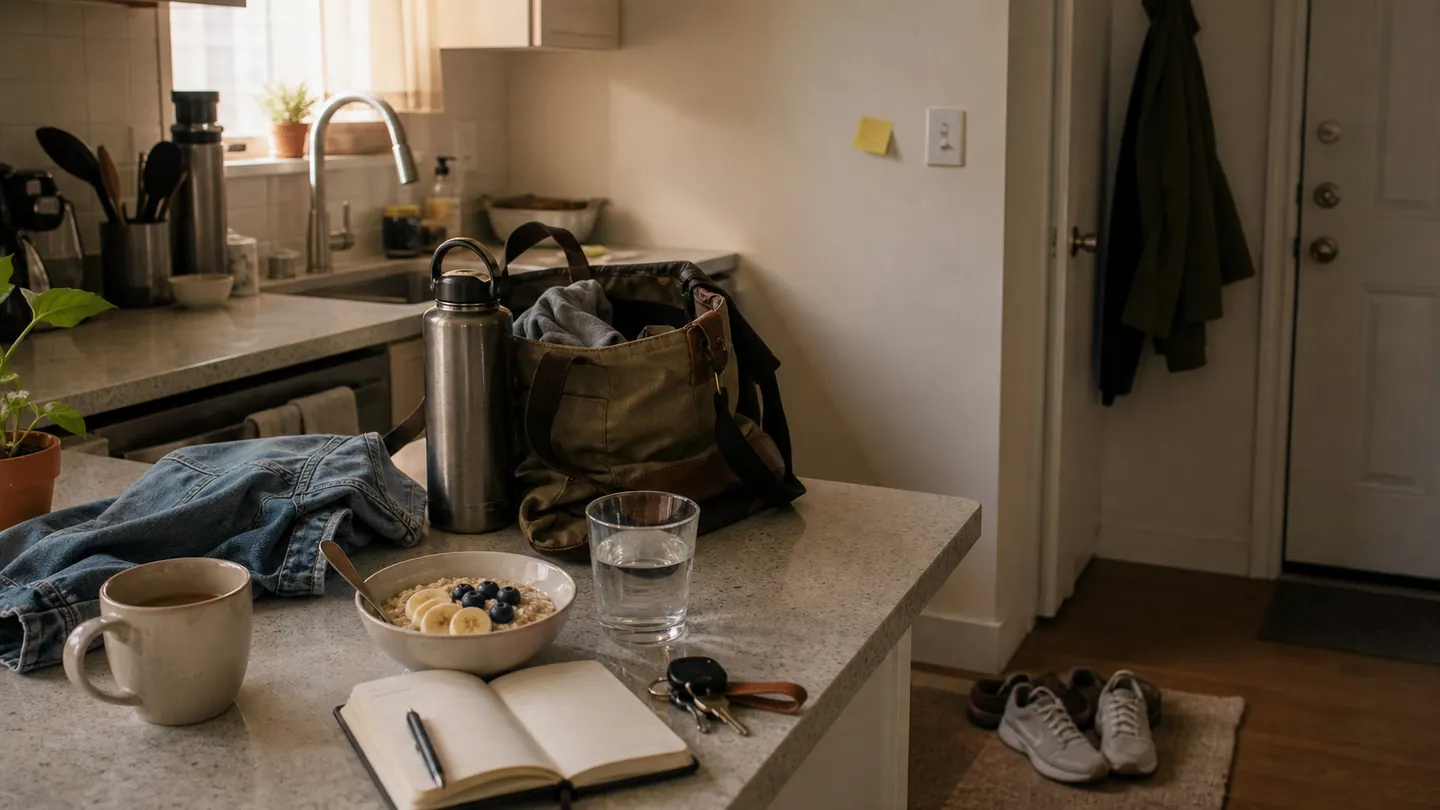
A realistic morning routine is a short sequence that fits the sleep, care duties, work schedule, health needs, space, and energy you actually have. It is not a competition to wake earliest or complete the longest list before breakfast.
The point is narrower: make the transition from waking to the next necessary activity less chaotic. For one person that means medication, breakfast, and a school run. For another it means opening a workshop. A good routine serves the morning; the morning does not exist to prove devotion to the routine.
Put sleep before the routine
A joint consensus from the American Academy of Sleep Medicine and Sleep Research Society recommends that adults generally obtain seven or more hours of sleep regularly. The statement also recognizes that healthy sleep involves quality, timing, regularity, and individual circumstances—not duration alone (Watson et al., 2015).
This is a general population recommendation, not personal medical advice. It does not prescribe a universal bedtime or wake time. It does provide a useful floor: do not routinely remove adequate sleep to create an impressive pre-dawn schedule.
If a routine worsens persistent sleep problems or daytime functioning, stop optimizing the sequence and seek appropriate assessment. The guide to sleep and mental health provides a wider educational context.
Respect chronotype and fixed constraints
Chronotype describes individual differences in preferred sleep-wake timing and related biological and psychological functioning. A comprehensive review supports this variation; it does not rank early schedules as morally or practically superior (Adan et al., 2012).
Begin with an honest constraint map:
- your required departure or login time;
- care, medication, food, mobility, or transport needs;
- the sleep window you are trying to protect;
- other people whose schedules affect the space;
- your typical alertness, without diagnosing your own chronotype.
Sketch two ordinary mornings before changing anything: one with your usual obligations and one with the disruption that occurs most often. Mark each step as fixed, movable, or optional. If caregiving, shifts, or transport create fundamentally different starts, design separate versions instead of averaging them into one ideal schedule. This exercise does not identify a perfect routine; it exposes practical conflicts before you add more steps.
There may be very little discretionary time. That is not failure. A ten-minute sequence that respects reality is more useful than a ninety-minute design that exists only on paper. The broader habits and behavior change guide can help you distinguish a difficult context from a character judgment.
Define one essential outcome
Ask: “What must this routine reliably prepare me to do next?” Possible answers include leaving home with essentials, beginning a focused task, helping children transition, or completing a basic care sequence.
Build backward from that outcome. Sort possible steps into:
- required: hygiene, food, medication, caregiving, transport;
- supportive: laying out materials, checking the calendar, brief movement;
- optional: reading, journaling, elaborate exercise, media, extra planning.
Keep required steps and add at most one supportive step for the first trial. Optional does not mean worthless; it means removable when the morning is constrained. If your essential outcome is a work block, time blocking can define what begins after the routine ends.
Choose a cue and a short sequence
Use an observable cue such as finishing breakfast, returning from a school run, or starting the computer. Then write the sequence in verbs:
After breakfast, I pack lunch, check keys and medication, then leave.
When the computer starts, I open the task list, choose today’s first deliverable, then work for ten minutes before messages.
In one 84-day randomized nutrition-behavior trial, routine-based and time-based cue plans both increased enactment and automaticity. Neither cue type was superior, and repeated enactment predicted automaticity (Keller et al., 2021).
That is indirect evidence about cue planning, not proof for any morning package. Choose a cue because it is feasible. For more detail on situation-response planning, see implementation intentions.
Build a fallback for disrupted mornings
A routine becomes realistic when it has a smaller form. Write three versions:
- standard: required steps plus one supportive step;
- compressed: required steps only;
- handoff: the first action moves to a later named time or place.
After a poor night, the answer may be more sleep, a slower start, or removing an optional task—not “discipline harder.” After an emergency, the handoff might simply be: “At lunch, I will review the missed appointment and reschedule.”
Avoid turning fallback into a secret punishment, such as skipping food or rushing unsafely to preserve a productivity block. Slow productivity offers a useful counterweight when morning design keeps expanding into performance theater.
Review the sequence without overinterpreting
Set a review date based on your schedule—after several representative mornings, not an evidence-free magical number. Note only what informs redesign:
- which cue actually occurred;
- which required step was missed;
- where waiting, searching, or deciding created friction;
- whether the routine displaced sleep;
- which optional step survived without pressure.
These observations cannot prove that one step caused your whole day to improve. They can reveal obvious mismatches: keys are never in one place, the cue occurs too late, or the sequence assumes an empty kitchen during a family rush.
Use a weekly review to change one element at a time. More tracking is not automatically better.
Keep what serves the next safe action
At review, ask:
- Did the routine protect sleep rather than compete with it?
- Did it fit my actual obligations and preferred timing?
- Did the cue occur reliably enough to be useful?
- Did the sequence support the essential outcome?
- Can I use the fallback without shame?
Remove any step that exists mainly to imitate someone else’s identity. Change the timing when work or caregiving changes. Keep a valued optional practice only if it fits without displacing essentials.
The smallest defensible morning routine is a protected sleep boundary, one feasible cue, a few necessary actions, and permission to adapt when the day begins differently. It should also tolerate seasonal changes, travel, illness, school calendars, and shared-household demands without turning each adaptation into a restart. A routine remains realistic when revision is part of its design.