Ten thousand hours is not a threshold at which expertise switches on. It is not a guarantee, a prescription, or a fair comparison across skills. The useful lesson behind the number is smaller: exceptional performance usually takes sustained, well-designed practice. The quality, timing, feedback, opportunity, and domain of that practice matter as much as the accumulated clock.
The popular rule compresses several different claims into one slogan. One claim is that extensive practice is necessary for high performance. Another is that a particular kind of deliberate practice improves performance. A much stronger claim is that anyone who completes a fixed number of hours will become world-class. Evidence for the first two does not establish the third.
Where the number came from
The best-known origin is a 1993 study by K. Anders Ericsson, Ralf Krampe, and Clemens Tesch-Römer. One part examined violin students at a Berlin music academy and used diaries plus retrospective estimates of practice. The most accomplished group estimated that they had accumulated more than 10,000 hours of practice alone by age twenty. The paper did not propose a universal 10,000-hour law, and an average within a selected sample is not a causal threshold for every learner (Ericsson, Krampe, and Tesch-Römer, 1993).
Several limits matter. The groups had already been selected into advanced musical training. Retrospective estimates can be inaccurate. Violin performance has established techniques, teachers, and evaluation standards that may not resemble entrepreneurship, writing, surgery, or scientific discovery. The study also concerned accumulated practice, not simply time spent near an instrument.
Later retellings removed those qualifications. “Many elite violinists estimated extensive practice” became “complete ten thousand hours and you will be elite.” That is a shift from an observation about a sample to a promise about an individual.
Practice matters, but it does not explain everything
A 2014 meta-analysis by Brooke Macnamara, David Hambrick, and Frederick Oswald found that deliberate practice was associated with performance, while the share of variation it accounted for differed substantially across domains. The authors concluded that practice is important but does not explain all differences in performance (Macnamara, Hambrick, and Oswald, 2014).
That paper also became part of a methodological dispute. Ericsson and Harwell argued that researchers often use “deliberate practice” too loosely, combining it with less structured forms of practice, and they reanalyzed aspects of the literature (Ericsson and Harwell, 2019). The disagreement is important: estimates depend on definitions, measurements, samples, and domains. It does not restore a universal hour rule.
Other contributors can include prior knowledge, physical characteristics relevant to a task, coaching, health, resources, access to competition, age of entry, and the quality of the learning environment. Some factors are changeable; some are not. Acknowledging them is not fatalism. It prevents practice from becoming a moral verdict in which every outcome is blamed on insufficient effort.
Gollius explores that distinction in talent versus effort and how skills develop.
What “better practice” looks like
Deliberate practice is not ordinary repetition with a more serious mood. In the original framework, it involves activities designed to improve performance, usually with a clear target, attention to errors, feedback, and repeated correction. It is demanding and specific to a field. That is closer to deliberate practice without myths than to counting every hour of work.
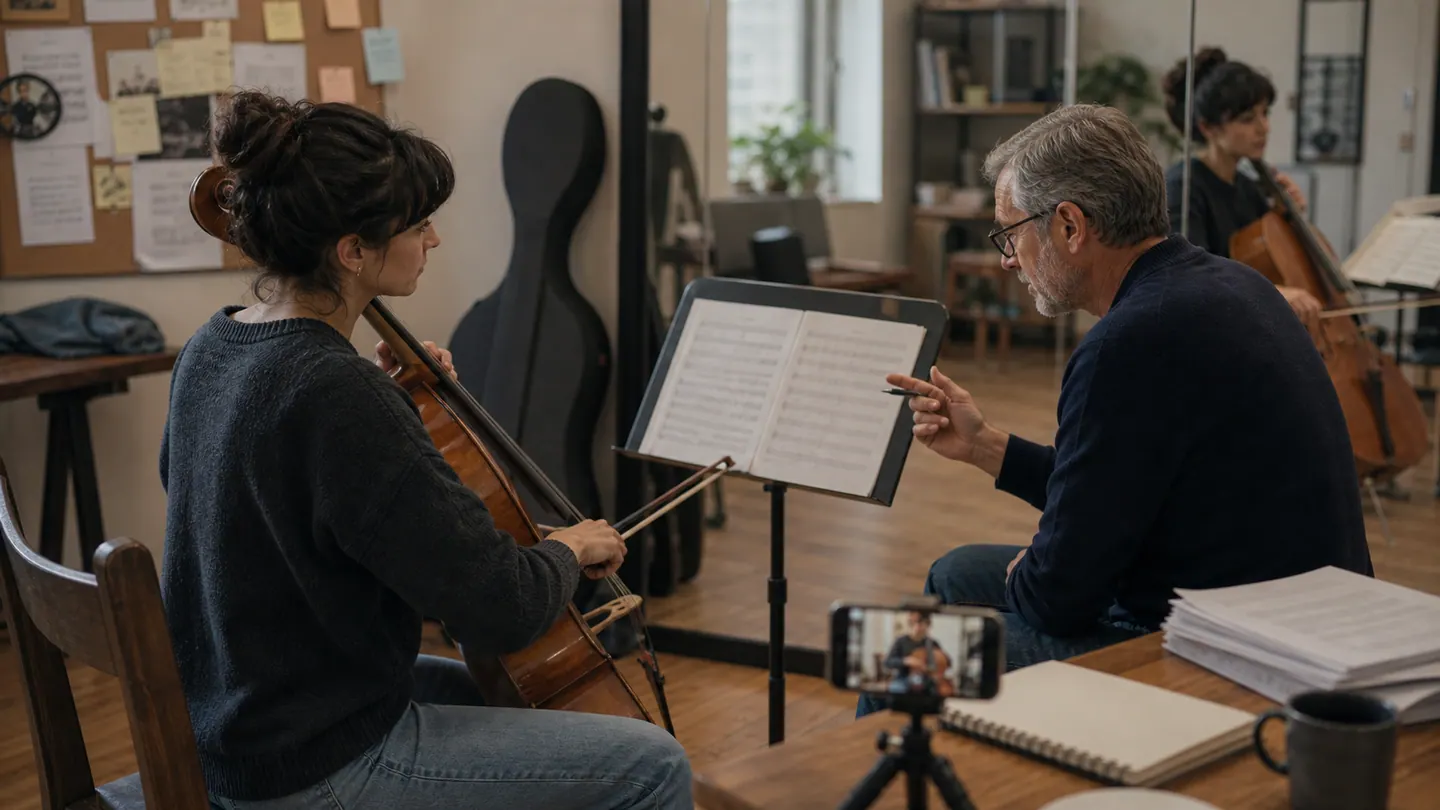
Consider a pianist who repeatedly plays a piece from beginning to end. The activity may maintain fluency and can be enjoyable, but it may preserve the same errors. A more diagnostic session identifies the transition that breaks down, slows or isolates it, compares the result with a reliable standard, changes fingering or timing, and retests it in context.
The same logic can apply elsewhere:
- A writer labels a recurring problem—unclear openings, unsupported claims, or weak transitions—and revises several examples with editorial feedback.
- A programmer predicts why a defect occurs, writes a minimal test, examines the failed mental model, and later solves a related problem without notes.
- A language learner records a short explanation, compares it with corrective feedback, then reuses the corrected pattern in a new conversation.
The task must remain difficult enough to reveal errors but tractable enough to permit correction. More strain is not automatically more learning. Performance during practice can also mislead: a blocked, familiar drill may feel fluent while producing weak transfer to new situations.
Replace the hour target with a practice audit
Hours are still useful for logistics. They show whether a project receives time and can reveal unrealistic expectations. They should be treated as an input measure, not proof of learning.
At the end of a practice cycle, ask:
- What precise capability was I trying to improve?
- What task exposed the gap rather than hiding it?
- What feedback did I receive, and how trustworthy was it?
- What changed in the next attempt?
- Can I perform the skill under a different condition?
- Is the bottleneck still practice, or is it instruction, equipment, health, access, or an incorrect goal?
For example, “I practiced presentations for twenty hours” says little. “I reduced unexplained jargon in three talks after reviewing audience questions, then tested a new explanation with an unfamiliar group” describes a learning loop. The quantities are illustrative; the meaningful information is what was tested and transferred.
Useful feedback needs enough specificity to guide a revision. Praise alone and humiliation both obscure the task. How to ask for useful feedback offers a practical companion, while mastery as a long process helps keep skill separate from identity.
How the myth can cause harm
The rule becomes commercially attractive because it turns a complicated path into a sellable certainty. A course can promise the “right” hours, a productivity system can display an authoritative counter, and a coach can reinterpret stalled progress as a need to purchase more access. None of those signals establishes that the practice design is valid.
The myth can also reward overtraining. Learners may ignore pain, sleep, plateaus, or deteriorating technique because every additional hour appears virtuous. In physical or performance domains, persistent pain, neurological symptoms, disordered eating, or severe exhaustion require qualified care, not a motivational demand to continue. Recovery is part of sustainable training; it is not evidence of weak commitment.
For children and early learners, a fixed-hour race can narrow exploration too soon and transfer adult status goals onto the learner. For adults, it can hide opportunity costs: becoming better at one activity means not investing the same time elsewhere. The right question is not “Can I reach ten thousand?” but “What level serves my purpose, and what does the next increment cost?”
A more honest conclusion
Do not aim for a magic number. Define a performance you value, observe your current attempt, isolate a limiting skill, obtain credible feedback, adjust the task, and test transfer. Track time if it helps you protect the work, but track errors corrected, capabilities gained, and conditions handled as well.
Mastery remains slow because complex skills require many adaptations. It remains uncertain because practice is only one influence and because fields change. That is less marketable than a universal rule, but more useful: you can improve the design of the next practice session even when nobody can promise where a lifetime total will place you.
Sources
- Ericsson, Krampe, and Tesch-Römer, “The Role of Deliberate Practice in the Acquisition of Expert Performance”, Psychological Review (1993).
- Macnamara, Hambrick, and Oswald, “Deliberate Practice and Performance in Music, Games, Sports, Education, and Professions: A Meta-Analysis”, Psychological Science (2014).
- Ericsson and Harwell, “Deliberate Practice and Proposed Limits on the Effects of Practice on the Acquisition of Expert Performance: Why the Original Definition Matters and Recommendations for Future Research”, Frontiers in Psychology (2019).