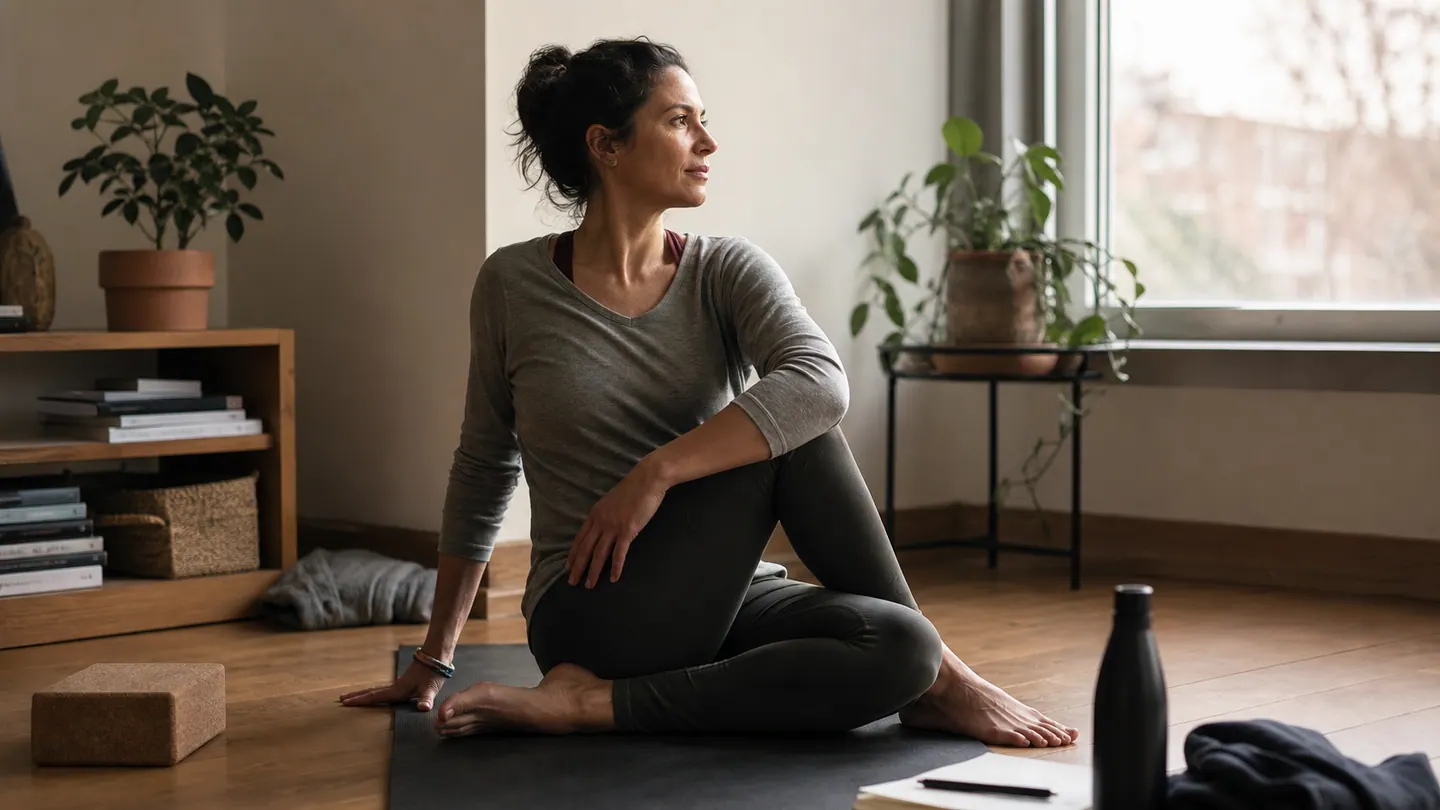
Yoga is not a single intervention. Depending on the tradition and setting, it may combine physical postures, breathing practices, meditation, ethical or spiritual teachings, heat, music, group instruction, and rest. A gentle chair-based class and a fast heated class place very different demands on the body.
That variety matters when asking whether yoga helps with stress. Research on one program does not validate every studio style, online sequence, forceful breathing exercise, or claim of emotional healing.
What the evidence supports
A 2024 systematic review and meta-analysis of yoga for stressed adults included randomized controlled trials from the general population. It found a short-term reduction in perceived stress compared with passive control groups, but rated that evidence as low quality. Programs varied, several studies had methodological limitations, and relatively few studies reported safety outcomes.
The National Center for Complementary and Integrative Health review of yoga likewise notes possible benefits for stress and several other wellbeing outcomes while emphasizing that yoga programs vary widely and research can be difficult to compare.
The proportionate conclusion is “may help some people,” not “regulates everyone’s nervous system.” Perceived stress is meaningful, but it is not the same outcome as treating an anxiety disorder, depression, trauma-related condition, chronic pain condition, or sleep disorder. Yoga can complement appropriate care; it should not be used to explain away persistent or severe symptoms.
Why yoga may feel useful
Several elements could contribute at once:
- movement can interrupt prolonged sitting and muscular bracing;
- attention to posture and contact can shift focus away from rumination;
- a predictable class can create a transition between demanding parts of the day;
- a supportive group or teacher can reduce isolation;
- rest and slower movement may make fatigue or tension easier to notice;
- choosing modifications can practice responding to limits without shame.
These are plausible pathways, not proof that one posture changes a particular hormone or “releases” a stored emotion. A useful session can remain useful without a grand biological story.
Match the form to the actual need
Begin with the stressor. If the problem is relentless workload, yoga may provide a pause but cannot reduce the workload by itself. If the problem is conflict, movement may create space before a conversation, but it cannot set the boundary. If the problem is persistent insomnia, panic, depression, or pain, a class may be supportive while evaluation and evidence-based care address the larger issue.
Then inspect the practice rather than trusting the label “beginner” or “wellness”:
- Does the teacher offer genuine options to rest, change a pose, keep eyes open, or leave?
- Is natural breathing allowed, or are students pressured into forceful breathing or long holds?
- Are props, chairs, and different ranges of motion treated as normal tools?
- Does the room temperature and pace fit the participant’s health and experience?
- Are touch and hands-on adjustments based on explicit, revocable consent?
- Does the teacher stay within their qualifications instead of diagnosing trauma or disease?
A class is not accessible merely because the marketing says “all levels.” Accessibility depends on cost, physical access, sensory environment, language, body diversity, and whether modifications are respected.
A practice does not need a fixed sequence
For stress, the useful ingredients are often ordinary: stable support, tolerable movement, choice, and a clear transition back to daily life. No universal duration, posture list, or intensity is required.
Within your current ability and any clinical guidance, you might choose supported standing, seated movement, floor-based practice, or simple mobility. Keep breathing comfortable. Move within a range that does not require forcing. Rest whenever you choose. End by noticing whether you feel settled, activated, tired, dizzy, emotionally stirred, or unchanged.
The result determines the next decision. Feeling activated may mean a slower style fits better. Fatigue may mean rest is more useful than another class. Recurrent pain or dizziness calls for assessment, not more determination.
Yoga should remain optional. Missing a session, changing a pose, or deciding that another form of movement suits you better is not a failure.
Safety and common injury risks
NCCIH describes yoga as generally safe for healthy people when practiced appropriately under qualified guidance. Sprains and strains are the most common injuries, serious injuries are rare, and people new to yoga are advised to avoid extreme practices such as headstands, shoulder stands, lotus position, and forceful breathing.
Stop a movement if it causes sharp or escalating pain, sudden weakness, loss of balance, numbness, severe headache, chest pain, faintness, or significant breathing difficulty. New or severe symptoms need appropriate medical assessment; call emergency services when symptoms may be life-threatening. Do not let a teacher reinterpret an alarming symptom as resistance, purification, or emotional release.
Extra planning or individualized guidance may be appropriate for pregnancy, older age, injury, osteoporosis, glaucoma, joint instability, cardiovascular or neurological conditions, recent surgery, balance problems, or other significant health concerns. The relevant clinician and a qualified instructor can help identify modifications. A generic online video cannot account for a personal diagnosis or medication.
Hot yoga adds heat stress and is not simply a more effective version of an ordinary class. Advanced inversions, competitive stretching, and forceful breath practices add distinct risks without being necessary for stress support.
Psychological fit and trauma-sensitive choice
Body focus, closed eyes, silence, close physical proximity, particular postures, or hands-on adjustments can be uncomfortable or destabilizing for some people. If a practice triggers panic, dissociation, traumatic memories, or a marked sense of being trapped, stop and orient to the room. Keep the eyes open, move to an exit, or leave. You do not owe the class an explanation.
A trauma-sensitive environment emphasizes invitation, predictability, and choice. It does not promise to “release trauma” through a posture. Someone with significant trauma-related symptoms should not be pressured to use yoga instead of licensed care. The same boundary applies to severe anxiety, depression, eating disorders, or other mental-health concerns.
Body-scan adaptations offer more detail on switching between internal and external attention. If breath manipulation is part of the class, review the distinct risks in breathwork.
Marketing, belonging, and cultural respect
Commercial yoga can turn flexibility, thinness, expensive clothing, dietary purity, or spiritual vocabulary into status. These signals do not measure teaching quality or health benefit. Be cautious when a studio treats pain as progress, discourages medical care, pressures students to buy escalating trainings, or gives a charismatic teacher authority beyond their competence.
Yoga also comes from living South Asian traditions, not from a contemporary fitness brand. A respectful practice does not need to imitate beliefs or language the participant does not understand, but it should avoid claiming that a commercial sequence invented ancient scientific certainty.
Keep it connected to the wider system
Yoga is most useful when it returns capacity to life. After practice, the next step might be rest, food, a work boundary, a medical appointment, a difficult conversation, or ordinary movement. Calm should not become a way to tolerate an unsafe or unsustainable situation.
Within integrated wellbeing, stress, and recovery, yoga is one possible form of movement and attention—not a requirement, identity, or universal treatment. Keep it if the form is accessible, the claims remain modest, and the practice expands choice. Modify it or leave it when pain, pressure, cost, hierarchy, or unwanted symptoms outweigh the benefit.