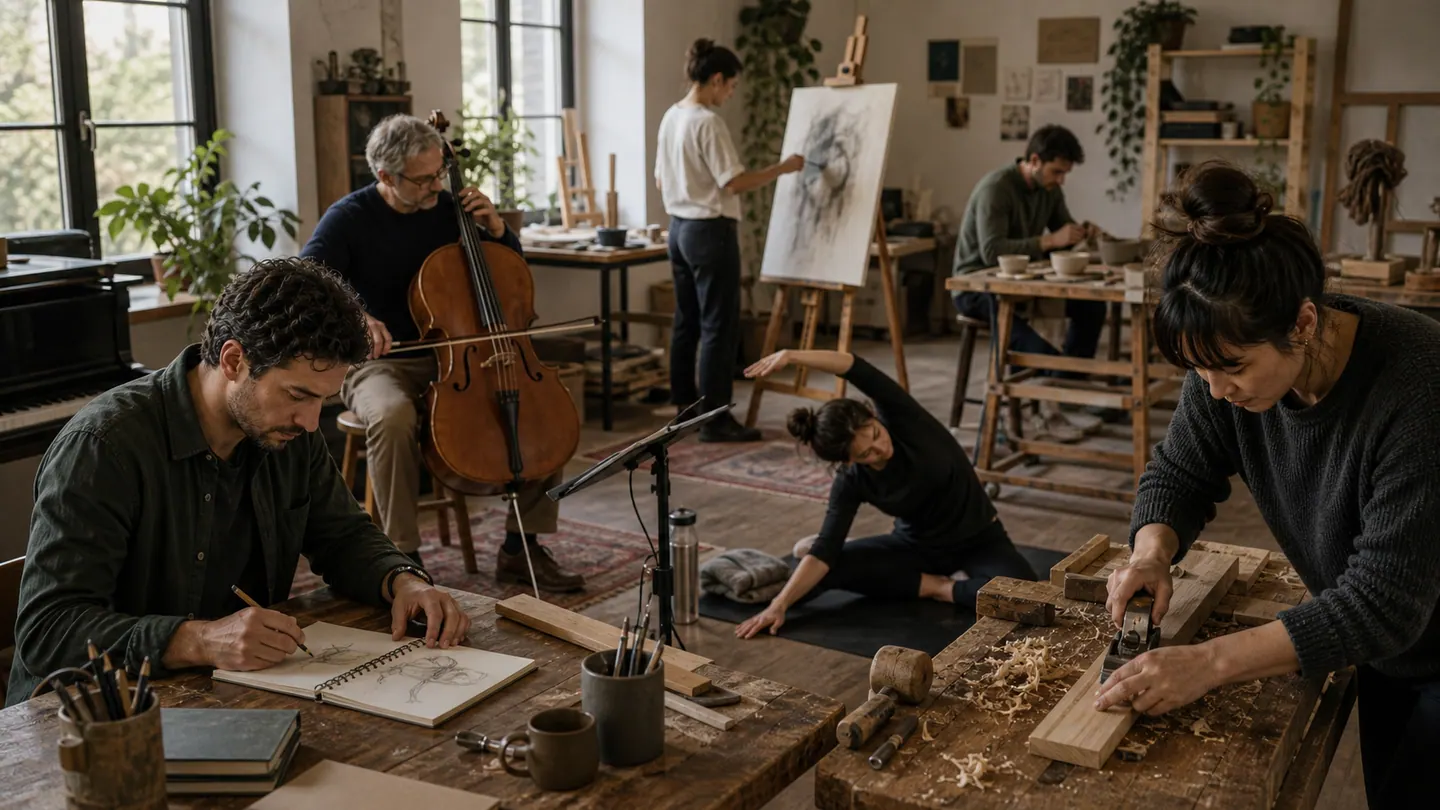
Creativity, learning, and mastery are often treated as separate gifts. In practice, they reinforce one another. Learning gives you material to work with. Practice improves control. Creative projects expose gaps that passive study can hide. Feedback helps you revise both the work and the way you train.
The useful question is not whether you are naturally talented. It is what kind of practice the next stage requires. A beginner needs vocabulary, examples, and quick attempts. An intermediate learner often needs narrower feedback and more difficult problems. An experienced practitioner may need new constraints, collaboration, or a project that forces old knowledge into a new shape.
Choose a skill you can observe
“Become more creative” is difficult to train because it does not specify an output. “Write a clear scene,” “sketch convincing hands,” “explain a technical concept without notes,” or “generate three workable solutions to a client problem” gives practice a target.
Define the skill at the level where another person could see it. Then identify its parts. Writing may involve idea generation, structure, sentences, revision, and audience judgment. Trying to improve all of them in every session creates noise. Choose the weakest relevant part and train it deliberately.
The guide to how skills really develop helps separate repetition, feedback, and increasing difficulty when the learning path still feels vague.
Build a loop between study and production
Input matters, but it becomes useful only when you can retrieve and apply it. A sturdy learning loop has four movements:
- Encounter: read, watch, listen, or observe an example with a question in mind.
- Retrieve: close the source and reconstruct the idea from memory.
- Apply: use the idea in a problem, explanation, sketch, performance, or decision.
- Review: compare the result with a standard and choose the next correction.
This loop is more demanding than highlighting or collecting notes, which is exactly why it reveals learning. If remembering is central to the task, active recall and spaced repetition can make review more selective and durable.
Match practice to the bottleneck
Not every difficult session is deliberate practice. Productive difficulty is specific: the task is just beyond current reliability, feedback is available, and another attempt is possible. Endless struggle without a diagnosis often trains frustration rather than skill.
Before practicing, name the bottleneck. Are you missing knowledge, speed, coordination, judgment, emotional tolerance, or a reliable process? If the problem is knowledge, study a model. If it is execution, isolate the movement. If it is judgment, compare several examples and explain the differences. If it is fear of evaluation, use smaller releases and a trusted feedback partner.
Our guide to deliberate practice without myths is the better next step when you need to design a demanding session without turning effort into punishment.
Use projects to connect the parts
Drills are efficient because they isolate a component. Projects are essential because they reveal whether the components work together. A musician may practice timing separately, then discover during a performance that attention collapses under pressure. A language learner may know vocabulary but struggle to form a response in conversation.
Choose projects small enough to finish and rich enough to expose trade-offs. A complete short essay teaches more about structure than ten abandoned introductions. A working prototype teaches more about constraints than an indefinitely expanding plan. Completion also creates artifacts you can compare over time.
Ask for feedback you can use
“What do you think?” invites taste and reassurance. Better requests identify the decision you are trying to improve: Where did the explanation become difficult to follow? Which part felt unsupported? What would you remove if the piece had to be shorter? What error repeats across these attempts?
Feedback is data, not a verdict on identity. One person's response may reveal a real problem, a preference, or a mismatch with the intended audience. Look for patterns, examine the work, and decide which change serves the goal. The ability to reject irrelevant feedback is part of mastery too.
Protect curiosity from perfectionism
Creativity needs a period in which weak ideas are allowed to exist. Evaluation introduced too early narrows the field before anything has developed. Separate generation from selection: produce alternatives first, then choose by explicit constraints such as usefulness, originality, cost, or clarity.
If starting repeatedly produces avoidance, examine the sources of creative block. The remedy differs when the obstacle is fear, fatigue, missing skill, unclear scope, or an environment built for interruption.
Review progress without worshipping the streak
A useful weekly review asks what you made, what improved, where you repeatedly stalled, and what the next practice should isolate. Count sessions only if the count helps you return. A long streak can coexist with shallow repetition, while a short, well-designed session can unlock a specific weakness.
Mastery has no final badge. It is the growing ability to notice more, choose better problems, and produce work with greater control. For the next seven days, select one visible skill, one bottleneck, one focused exercise, and one small project. That is enough structure to turn aspiration into learning while leaving room for discovery.